Gas Scrubbers: Models and Configurations

Gas Scrubbers: Models and Configurations
The right gas scrubber starts with your process
Which gas scrubber best suits your application depends on various process and emission parameters, including:
- the composition of the gas stream
- the contaminants present
- the desired process control
- the required emission reduction / emission limits
- BAT/BBT
- permit requirements
Based on this information, CGK selects and designs the most suitable system.
Various design options:
For each application, we select the technology that offers the best balance between capital cost, operating cost, energy consumption, environmental impact, maintenance, and emissions performance. This optimal configuration results from a combination of various design choices:
Contact principle
Packed bed for efficient absorption, spray washing for a simple and robust design, tray columns for specific process applications, or another gas-liquid contact system tailored to the gas flow.
Wash liquid
The choice depends on the nature of the contamination and the desired removal. Possible washing fluids include water, acidic or basic solutions, basic-oxidative fluids, biologically active wash water, lime slurry, and oil.
Flow direction
Countercurrent flow for efficient mass transfer between gas and liquid, co-current flow for high loads, and cross-current flow for compact systems.
Number of washing stages
Single-stage for simple gas flows; multi-stage when different components or treatments need to be combined.
Configuration
A gas scrubber can be designed as a vertical or horizontal unit. A vertical gas scrubber has a compact footprint and is often configured as a counterflow system. A horizontal gas scrubber is particularly suitable when headroom is limited or when the unit must be integrated into an existing air duct.
Typical Solutions
Multi-stage gas scrubbers
For stringent emission requirements
Scrubber + filter
For odors or residual components
Custom hybrid system
For complex gas streams
Not sure which gas scrubber is right for your process?
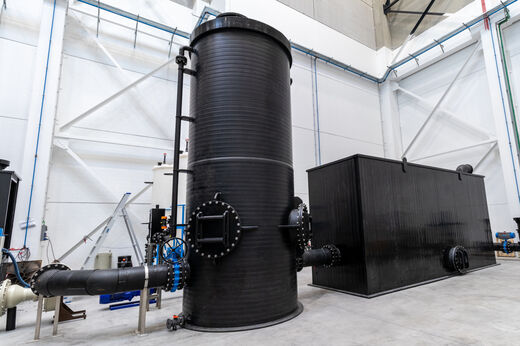
Gas scrubber combined with other techniques
For complex emissions, gas scrubbing can be combined with other treatment steps.
Possible combinations include:
- droplet separator
- activated carbon filter
- vapor or cartridge filter
- biofilter
- aerosol or dust filter
- second chemical scrubbing stage
The various technologies are arranged in a logical sequence. This allows a gas scrubber to first remove the largest or most corrosive contaminants, after which a filter treats the remaining components.
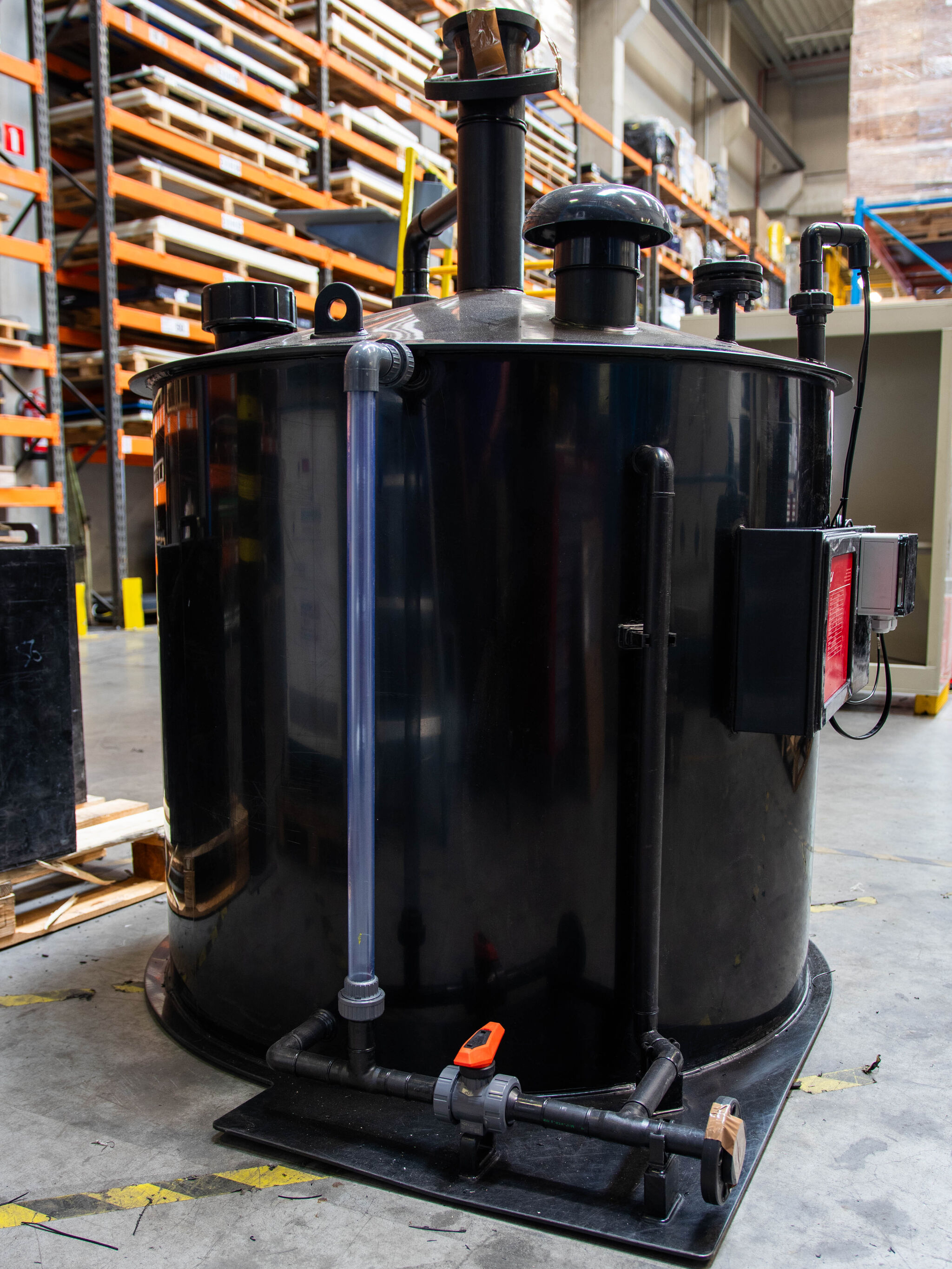
Automation and Process Monitoring
Proper process control ensures reliable operation and minimizes water and chemical consumption.
Depending on the installation, CGK Group can equip the gas scrubber with measurement, control, and safety systems.
Measurements and Control
We measure key process parameters such as pH, redox, conductivity, flow rates, pressure, level, and temperature. Based on these measurements, we automatically control water and chemical dosing, blowdown, and level control.
Monitoring and Safety
The system can be equipped with pump and fan monitoring, dry-run and level protection, leak and pressure monitoring, and alarm notifications.
Integration with Control Systems
The gas scrubber can be integrated with a PLC, control panel, or building management system, allowing you to monitor all process data and alarms centrally.
The automation is always tailored to your application and desired level of complexity.
Discuss your gas flow with our engineers
Are you experiencing issues with acid fumes, ammonia, odor, or other harmful emissions? Or are you unsure whether your current gas scrubber still meets process and emission requirements?
If possible,please provide us with the following information: the type of process or emission source, the substances that need to be removed, the concentrations present, the normal and maximum gas flow rates, the temperature, the desired emission limit, and details about the existing system.