When do I need a storage tank?
When is it better to choose a storage tank instead of a small container such as a barrel or IBC? How much space is required for installation? What are the safety implications for your personnel? And finally, what is the cost of such an installation? You will find the answer below in a detailed cost-benefit analysis.
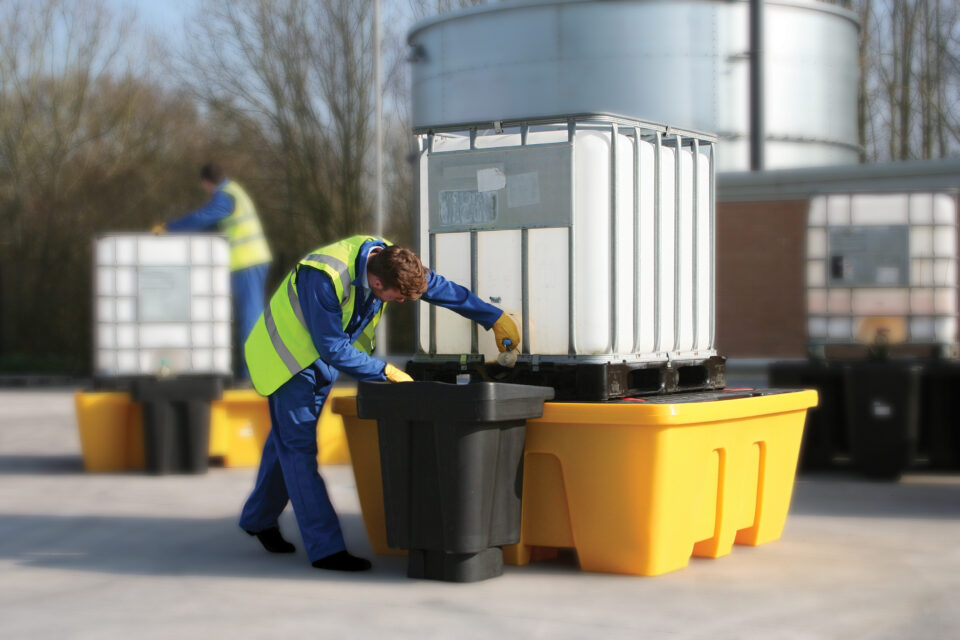
Storage in bulk or small quantities
A bulk tank has 4 major advantages over smaller packages:
- Your product will be much cheaper. No more supplier costs for filling or cleaning IBCs, drums and jerry cans. In addition, the number of deliveries is reduced. So you will buy cheaper.
- You work more efficiently. You no longer have to transport chemicals, connect pumps and install fittings. And with no product loss, unlike IBCs and empty drums, which often contain residues.
- Your staff saves time because they no longer have to move IBCs and drums. This time saving is even more important if you have large consumers.
- Less risk of accidents and leaks.

Case study: find out for yourself if a storage tank is for you
Suppose your company's production uses 4 IBCs of NaOH per month. That's 4,000 liters/month. In this case, is it better to use separate IBCs or a storage tank?
Cost of storage tanks (bulk storage).
Cost of a storage tank
An 8 m³ storage tank provides a 2-month supply and thus 6 deliveries per year. This double-walled tank is made of plastic (because NaOH is corrosive) and fully complies with legislation: filling system, leak detection, level indicator, overflow protection and ventilation.
The price of this well-considered investment is €13,500.
Cost of individual IBCs
Rental and cleaning of an IBC with NaOH
Rent at €1.5/day = €45/month
Per month: for 4 IBCs :
4 x €45 = €180
Per year :
12 x €180 = €2160
Surcharge for the purchase of IBCs containing NaOH
The difference in cost of NaOH between bulk and IBC storage is €116/1000 liters = €0.116/liter. This means that you pay €116/1000 liters more for storage in IBCs than for a storage tank (taking into account the density of 1.309 kg/liter).
Per month: for 4 IBCs :
- Consumption of 4000 liters
- 4000 liters x €0.116 = €464.
Per year :
12 x €464 = €5568
Conclusion
Storage in tanks is significantly more economical than storage in IBCs. Using IBCs costs €7728 more per year (€2160 + €5568) than bulk storage in a chemical tank.
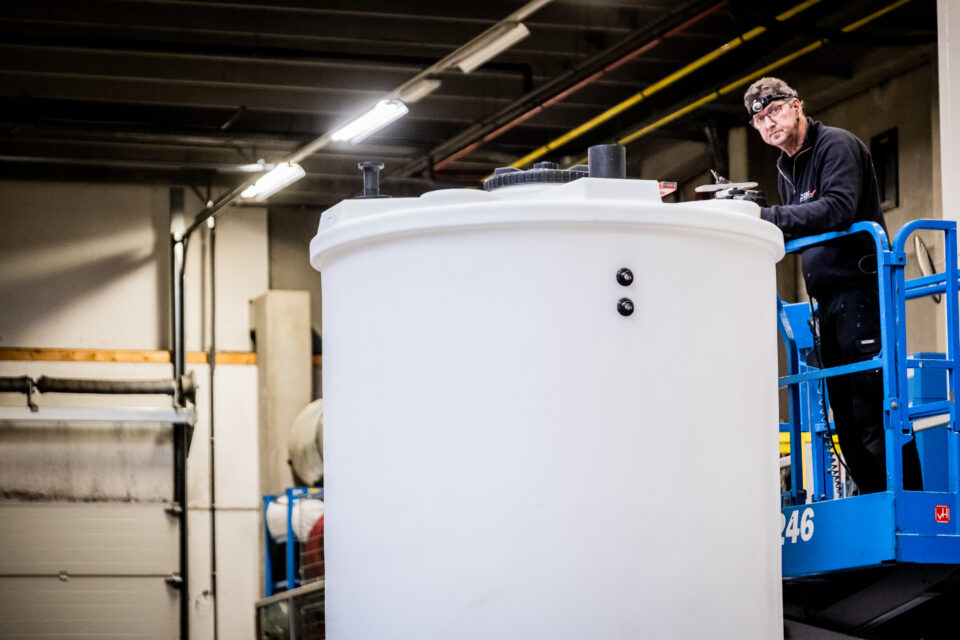
Calculating the recovery period
Your investment in a storage tank will pay for itself in 2 years, taking into account 2026 rates. But not including
- Holding tanks to legally store your IBCs.
- Time savings because storage tanks require fewer operations.
- Costs associated with leaks during internal transport of IBCs and drums.
- Mandatory triennial tank inspections.
- The lifespan of these tanks is estimated at 5 to 25 years.
- Want to combine the benefits of IBCs and bulk storage? Then choose a mother-daughter tank into which you empty the IBC.
Starting at 5,000 liters, prices become attractive. So make sure you come to an agreement with your supplier.
Make sure you have a spare. When you fill your tank, it is impossible to drive it completely empty.
Free quote for your tank
Do you have a precise idea of the tank you need? Let us know all the specifications and we'll give you a realistic quote.
Worker safety
Transporting chemicals with IBCs and drums is a high-risk activity. Safety in and around the workplace is therefore a very important aspect. For example, employees must open lids, suction and move hoses. By storing chemicals in bulk in a tank, the associated risks are reduced or eliminated altogether.
Do I have room for a catch basin?
This cost-benefit analysis shows that a storage tank is the most economical and safest solution. But do you have enough space for such a tank? Below are the most common tank volumes and sizes:
Tank Capacity
5 m³
10 m³
15 m³
20 m³
30 m³
40 m³
Dimensions (in meters)
ø 1.95 x height 2.5
ø 2.5 x height 3.5
ø 2.9 x height 3.5
ø 2.8 x height 5.5
ø 3.6 x height 4.5
ø 3.5 x height 5.5
Waterproof unloading dock
To fill a tank responsibly, you need not only adequate space, but also a filling point and an unloading site. A discharge point is a liquid-proof area where the tanker stands to legally fill or pick up liquid waste. Do you have several tankers? Then one unloading site will suffice, even for acids and bases.
How large should an unloading site be?
The Flemish government requires an unloading quay of 4 x 2 meters. Depending on the risk analysis, this rule can be deviated from. This should be discussed with the competent supervisory authority. Want to know more about the current rules? See section 5.17.4.1.16 of the Vlarem II legislation.
Caulking / drip tray
A sump or recovery tank is used to collect product in the event of a tank leak. The type of sump tank has a major impact on the space occupied by the system. Sometimes there are holes in the collection tank, for example for pump lines or rainwater drainage. CGK makes these holes 100% waterproof.